
How Much Does Spray Foam Insulation Cost in Lancaster?
Our Spray Foam Insulation services in Lancaster, CA typically cost between $1.50 and $4.50 per board foot, depending on foam type, application area, and current project conditions. Most Lancaster homeowners spend between $1,800 and $6,500 for a full attic or crawl space application, with open-cell foam running lower and closed-cell foam landing at the higher end. We publish a flat written price before any work starts – no vague ranges handed to you at the door.
Spray Foam Insulation Cost Breakdown (2026)
Spray foam pricing in Lancaster breaks down by foam type and application zone. The numbers below reflect what we’re seeing in the Antelope Valley market in 2026 – jobs in Quartz Hill and the newer tracts east of the 14 freeway tend to fall in the middle of each range, while older homes in west Lancaster with more complex framing cavities or existing moisture issues can push toward the top.
| Application / Foam Type | Typical Cost Range (Lancaster, CA) | Notes |
|---|---|---|
| Open-cell spray foam – attic (per board foot) | $1.50 – $2.25 | Vapor-permeable; good for vented attic rafter bays |
| Closed-cell spray foam – attic (per board foot) | $3.00 – $4.50 | Vapor retarder; preferred for unvented assemblies and flat rooflines |
| Closed-cell spray foam – crawl space walls | $2.75 – $4.25 | Standard for encapsulated crawl spaces |
| Spray foam – rim joists (per linear foot) | $3.50 – $6.00 | High-value air sealing for any two-story home or raised foundation |
| Spray foam – wall cavities (new construction or open wall) | $2.00 – $3.75 per board foot | Open wall required; often paired with framing stage |
| Spray foam – garage ceiling (conditioned above) | $1,400 – $3,200 total | Common in Lancaster two-car garages under bonus rooms |
| Typical full attic – 1,200 sq ft home | $1,800 – $3,600 | Open-cell to closed-cell range; includes prep and cleanup |
| Typical full attic – 2,000 sq ft home | $2,800 – $6,500 | Closed-cell on larger homes with complex rooflines runs higher |
A board foot is one square foot of surface area covered to one inch of depth. When you see “3 inches of closed-cell,” that’s 3 board feet per square foot of coverage. A 1,200-square-foot attic floor sprayed with 2 inches of closed-cell foam equals 2,400 board feet. At $3.50 per board foot, the material and labor cost lands around $8,400 for that zone alone – which is why the application area and thickness spec drive your number more than almost anything else.
Older homes in west Lancaster – particularly those built in the 1970s and 1980s along Sierra Highway and the blocks near Avenue I – tend to have more penetrations, gaps, and prior insulation that needs removal before spray foam can go in. That removal step typically adds $400 to $1,200 to a project, and skipping it isn’t an option we offer. At Envelope Insulation Co., we don’t spray over problem conditions; we document them first, write a scope that addresses them, and then price the whole job before anyone picks up a hose.
What Affects Spray Foam Insulation Pricing in Lancaster
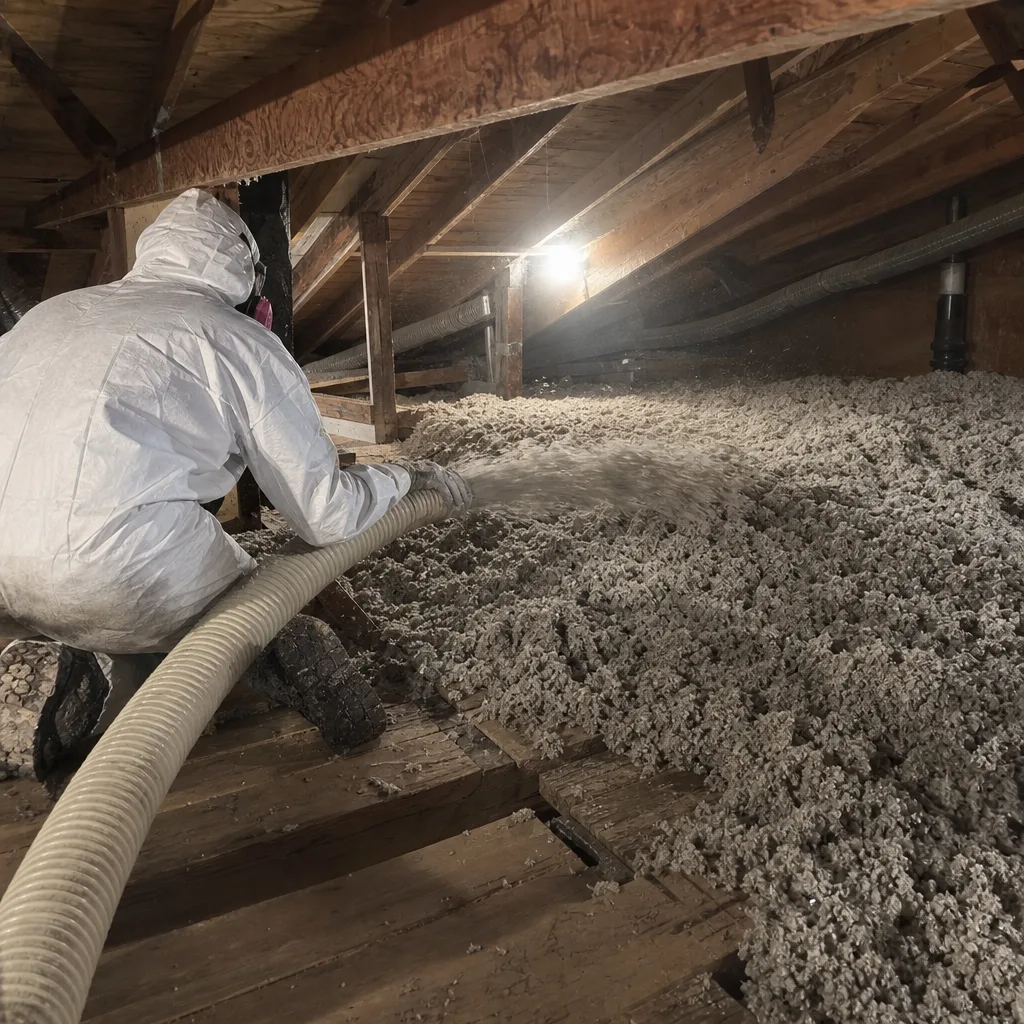
- Foam type: open-cell vs. closed-cell. Open-cell foam (roughly R-3.7 per inch) costs significantly less per board foot than closed-cell (roughly R-6.5 per inch). In Lancaster’s desert climate – where attic temperatures routinely reach 140-160°F in July and August – closed-cell is often the better technical choice for unvented assemblies, even though it costs more upfront. The tighter vapor control pays back in a climate that swings 50 degrees between a January night in Palmdale and a July afternoon in Lancaster.
- Application area and access conditions. A flat, open attic floor in a ranch-style home on 30th Street West is one of the faster setups we work in. A 1970s split-level with a low-slope roof, HVAC trunks running through the attic, and three different ceiling heights is a different job entirely. Tight access adds setup time, and setup time is in the price.
- Existing insulation removal. Lancaster has a lot of housing stock from the late 1980s and 1990s that still has original blown fiberglass sitting on the attic floor – sometimes mixed with vermiculite or badly settled batts. If spray foam is going on the attic floor or rafter bays, that material has to come out first. Removal in Lancaster runs $0.75 to $1.50 per square foot depending on depth and contamination.
- Air sealing requirements before foam is applied. We seal before we spray – always. That means top plates, can lights, plumbing penetrations, and any HVAC chase openings get sealed with two-part foam or caulk before the spray rig rolls in. Air sealing is a prerequisite at Envelope Insulation Co., not an upsell. In practice, this step takes one to three hours on a typical Lancaster home and is already included in the written scope you receive before work begins.
- Roof geometry and attic complexity. The newer subdivisions north of Avenue K – Westridge, the Stetson Ranch area – tend to have complex rooflines with multiple hip sections, which creates more linear feet of rafter bay to spray and more hard-to-reach corners. Complex geometry adds 15-25% to foam labor compared to a simple gable-end ranch.
- Material costs tied to regional supply. Closed-cell foam uses blowing agents that have fluctuated in cost since 2021. Lancaster sits far enough from the LA basin that trucking costs for materials are a real factor – we source from Icynene, Demilec, and other suppliers, and our material line is itemized in your written price so you can see exactly what you’re paying for each component.
Open-Cell vs. Closed-Cell: Which One Does Lancaster Need?
This question comes up on nearly every estimate we run in Lancaster. The short answer: most attic applications in the Antelope Valley benefit from closed-cell, but the longer answer depends on the assembly.
Open-cell foam is vapor-permeable and expands dramatically – it fills irregular cavities well and costs less. It’s a reasonable choice in vented attic assemblies where you’re spraying the floor, not the roof deck. But in Lancaster’s climate, an unvented attic with open-cell foam on the roof deck can accumulate moisture during the cool winter months if the vapor drive isn’t managed. We’ve seen this on homes in the Ritter Ranch area that had open-cell applied without a vapor retarder – by the time a homeowner calls us about a musty attic smell, there’s often mold on the sheathing.
Closed-cell foam acts as its own vapor retarder at 2 inches or more and adds structural rigidity to roof sheathing – a minor but measurable benefit during the high-wind events that hit the Antelope Valley off the Tehachapi passes in spring and fall. For conditioned crawl spaces, closed-cell on foundation walls is standard; it handles the soil moisture drive that an open crawl in Lancaster can see even in dry years.
We’ll tell you which foam type belongs in each zone of your home in the written scope. If a cheaper option performs just as well for your assembly, that’s what we specify – we don’t default to closed-cell because it has a higher price tag.
Spray Foam vs. Other Insulation Types: Cost Comparison for Lancaster Homes
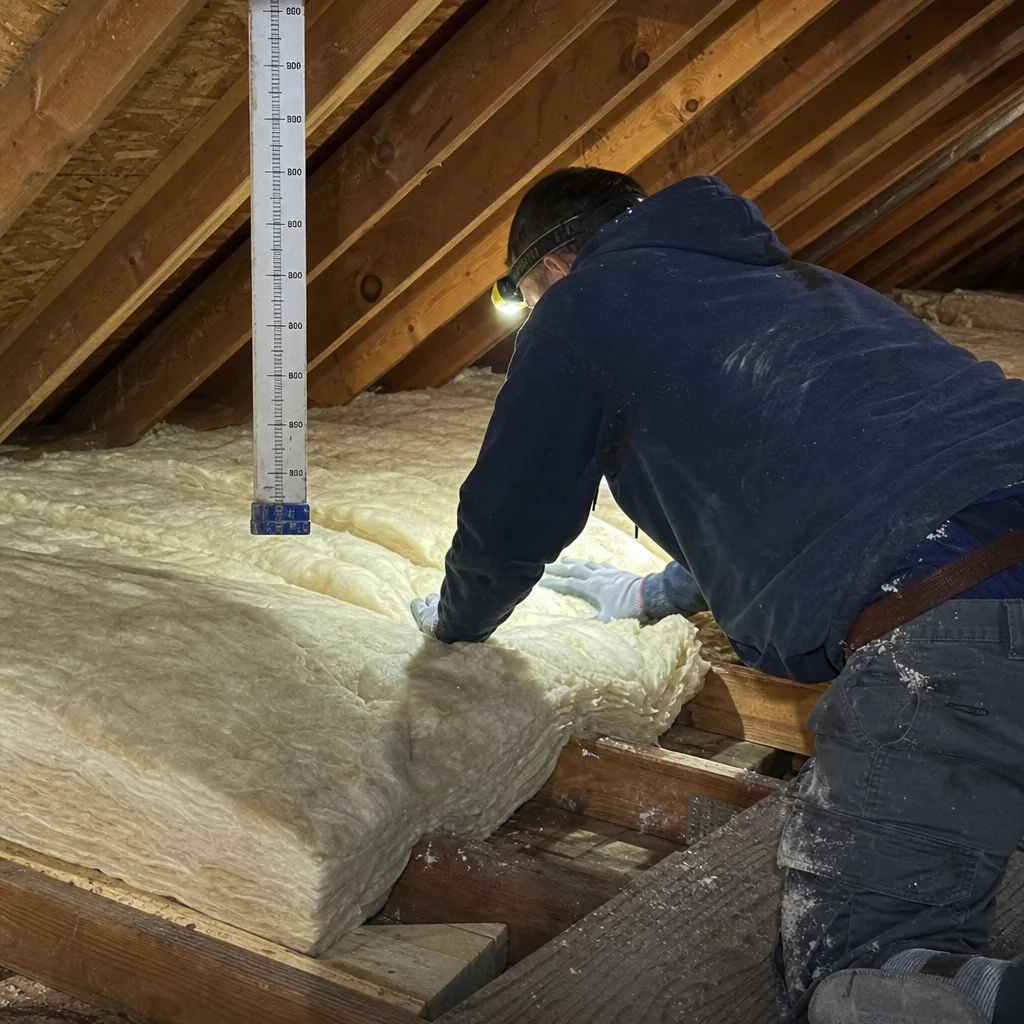
Spray foam costs more per square foot than blown-in fiberglass or cellulose. That’s not a reason to avoid it – or a reason to always choose it. Here’s how the materials stack up in the Lancaster market as of 2026.
- Blown-in fiberglass (attic floor): $0.60 – $1.10 per square foot installed. Lowest upfront cost; no air sealing built in.
- Blown-in cellulose (attic floor): $0.80 – $1.30 per square foot installed. Better air resistance than fiberglass; still not a substitute for sealing penetrations first.
- Fiberglass batts (wall cavities): $0.50 – $0.90 per square foot. Lowest cost, lowest air resistance. Common in Lancaster new construction at the entry-level price point.
- Open-cell spray foam: $1.50 – $2.25 per board foot. Air barrier and insulation in one pass. Better for attic rafter bays in vented assemblies.
- Closed-cell spray foam: $3.00 – $4.50 per board foot. Air barrier, vapor retarder, and insulation in one pass. Strongest performance-to-thickness ratio of any insulation type.
- Rigid foam board (walls, basement/crawl): $1.00 – $2.50 per square foot installed. Good in specific assemblies; labor-intensive at joints and penetrations.
Where spray foam earns its price premium is in applications where air leakage is the primary energy loss driver. A blower-door test – a pressurization reading that shows, in a single number, how much conditioned air your building envelope is losing – often reveals that the attic floor accounts for 40-60% of a Lancaster home’s total air leakage. In those cases, closed-cell foam applied to the rafter bays or a combination of air sealing plus blown-in on the floor will outperform a thick layer of fiberglass batts that lets conditioned air bypass the fiber entirely.
We run a blower-door test before and after every applicable job. The before number and the after number both go in your documented job record. That way you’re not taking anyone’s word for the performance improvement – you can read it yourself.
How to Save on Spray Foam Insulation in Lancaster
Spray foam isn’t the cheapest insulation on a per-square-foot basis, but there are legitimate ways to reduce your total project cost without cutting corners on performance.
- Combine spray foam with blown-in where the assembly allows it. Not every surface in your attic needs closed-cell. A common approach on Lancaster homes is to seal the attic floor penetrations with two-part foam, then blow cellulose or fiberglass to depth over the floor – saving closed-cell for rafter bays and the rim joist where it earns its keep. A well-designed hybrid job costs less than full closed-cell and often performs comparably.
- Schedule during the cooler months. Spray foam reacts to temperature and humidity. In Lancaster, summer attic temperatures make foam application harder – more passes, more material off-gassing, longer cure waits. October through March tends to be better for attic work, and some contractors pass a portion of that efficiency back to the customer.
- Pull a permit and do it right the first time. Los Angeles County building code requires a permit for insulation replacement in most renovation contexts. Unpermitted spray foam work can create problems at resale and can void manufacturer warranties. Permitted work done once correctly costs less than unpermitted work done twice.
- Check for utility rebates before signing anything. Southern California Gas and SCE both run energy efficiency rebate programs that can offset $200-$800 on qualifying insulation projects in Lancaster. Eligibility depends on current program funding and the R-value improvement documented by the contractor. Ask us for current program details when you request your written estimate.
- Get a second opinion on any written estimate you already have. We offer a free second opinion on any competing written estimate – we’ll read the scope with you, line by line, and tell you whether the spec makes technical sense for your home and what you might be missing. No pressure, no obligation. If the other contractor’s plan is solid, we’ll say so. Call (661) 526-2890 to set that up.
- Don’t add spray foam to a leaking roof or active moisture problem. This sounds obvious, but we see it. Spray foam over an active moisture intrusion traps the moisture and accelerates rot. Fixing a foam-encapsulated moisture problem costs far more than fixing the moisture problem first. Addressing the source before calling us is the cheapest decision you can make.
Our Spray Foam Insulation in Lancaster service page walks through the full scope of what a typical project involves, including the air sealing work that happens before the foam ever goes in. That page is worth reading before you compare quotes, because not every estimate you receive will include the same scope.
What the Installation Process Looks Like in Lancaster
We describe the documentation the customer walks away with because that’s what “done” looks like – not a contractor driving away. Here’s the sequence on a standard Lancaster spray foam job.
1. Written Price Before Any Work Starts
Under Haven Standard Clause 1, you receive a flat written price, a written scope describing every task, and a written warranty before anyone lifts a tool. The scope names the foam type, the target thickness, the application zones, the air sealing work that precedes foam, and what cleanup looks like. If you need to change the scope, the price changes in writing too – no surprises on invoice day.
2. Pre-Job Blower-Door Test
On applicable jobs, we run a blower-door test before work starts. This gives us a baseline CFM50 reading – the cubic feet per minute of air loss at 50 pascals of pressure difference – so the after number means something. Lancaster homes with original 1980s construction typically read between 3,500 and 6,000 CFM50. Tighter newer builds in the Avenue L corridor sometimes come in under 2,500. We document the pre-job number and include it in your job record.
3. Air Sealing First
We seal before we spray. Top plates, can lights, plumbing penetrations, electrical chases – all of it gets sealed with two-part foam or caulk before the spray rig comes in. We won’t apply insulation over an unsealed attic floor. This is a hard rule, not a sales line. The air sealing step typically takes one to three hours depending on the home’s age and the number of penetrations.
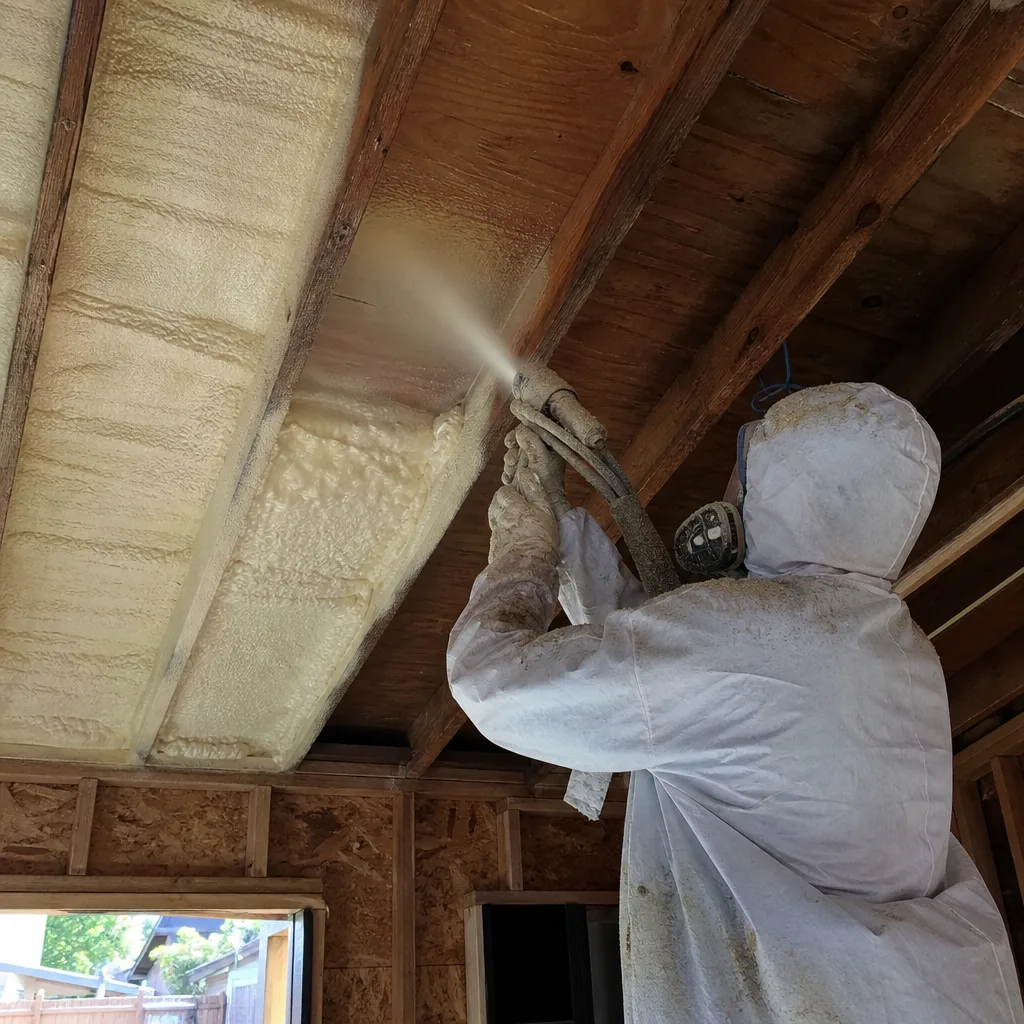
4. Spray Foam Application
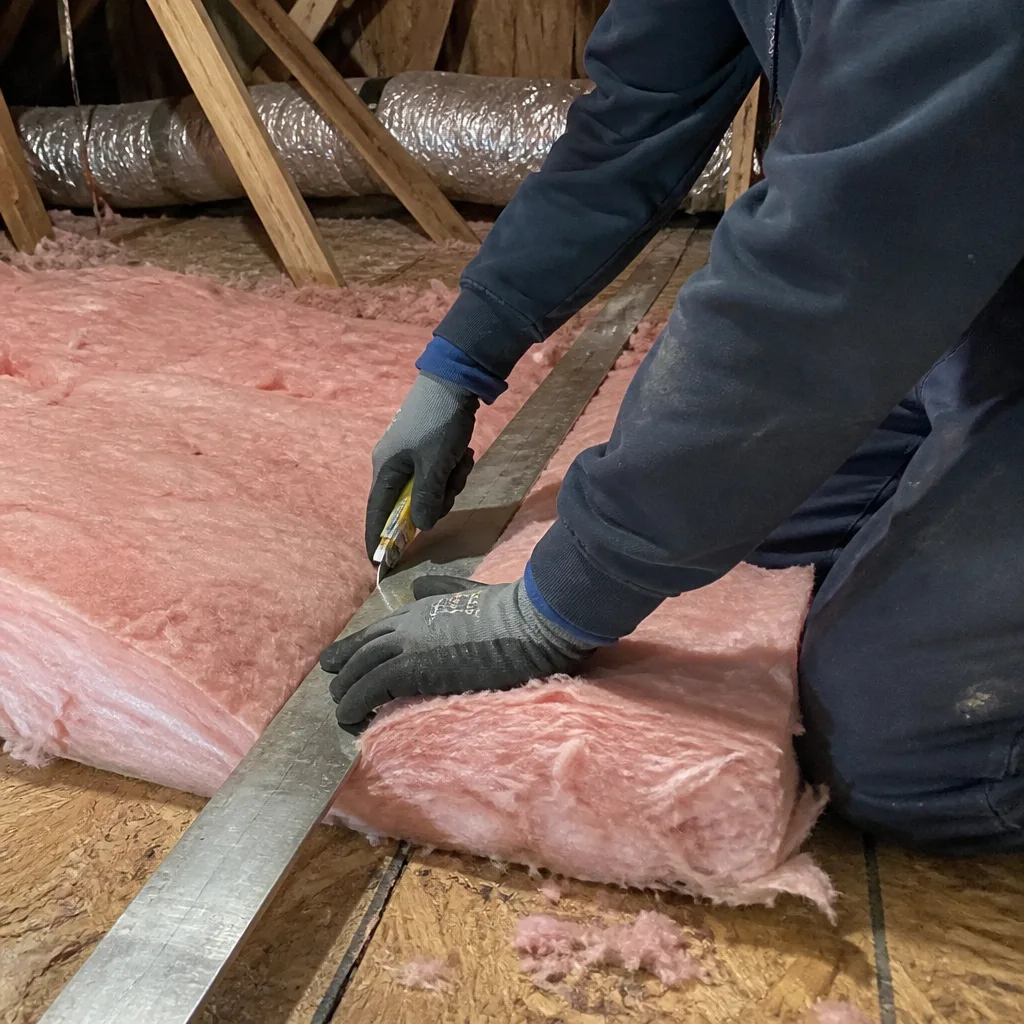
The foam rig heats and mixes the A and B components at the gun. Application thickness is measured with a pin gauge during the job – not estimated. We hit the specified depth in the written scope. Cure time varies by product and temperature; in a Lancaster July attic, that can be as short as 30 minutes to tack-free, but we don’t close the space until the manufacturer’s full cure spec is met.
5. Post-Job Blower-Door Test and Documented Photo Record
After foam is cured and cleaned up, we run the blower-door again. Both numbers go into your Documented Photo Record – the same record that includes photos of the pre-job conditions, the air sealing work, and the finished foam application. You get this record when we leave, not available on request. If the after number doesn’t reflect the improvement the scope promised, we make it right under the 365-Day Done Right Promise before we consider the job closed.
Spray Foam and Lancaster’s Climate: Why the Desert Matters Here
Lancaster sits at roughly 2,300 feet elevation in the Antelope Valley, and the climate does things that most insulation guides written for the LA basin don’t account for. Summers are genuinely hot – July highs average near 100°F, and attic temperatures in an under-insulated home can reach 155-165°F. But winters are cold by Southern California standards; January lows regularly fall below freezing, and the wind events off the Tehachapi Mountains can drop effective temperatures further.
That swing matters for insulation performance. A vapor barrier that makes sense in a humid coastal climate behaves differently at Lancaster’s desert humidity levels. Closed-cell foam’s vapor retarder function is less critical on the floor plane in a dry-climate vented attic than it would be in a humid assembly – but its air barrier function matters enormously, because dry or not, conditioned air escaping through a leaky attic floor in July is $40-$80 per month in wasted cooling costs on a mid-size home.
We’ve been running blower-door numbers on Lancaster homes since 2016. The pattern we see most often: homes built in the late 1980s to mid-1990s, particularly in the east Lancaster grid between 20th Street East and Sierra Highway, have attic floors with large unsealed top plates, original can lights without covers, and fiberglass batts that have settled to 40-60% of their original R-value. On those homes, spray foam on the rafter bays plus a sealed floor delivers the most measurable air-sealing improvement of any insulation approach we use.
If you want to see what that looks like in measured terms, our home page includes documented before-and-after blower-door results from completed jobs.
FAQs – Spray Foam Insulation Cost in Lancaster, CA
How much does spray foam insulation cost per square foot in Lancaster?
Spray foam in Lancaster costs $1.50 to $4.50 per board foot installed, which translates to roughly $1.50 to $9.00 per square foot of coverage depending on the application thickness. Open-cell foam at 3 inches runs about $4.50 to $6.75 per square foot; closed-cell at 2 inches runs about $6.00 to $9.00 per square foot. Most homeowners think in total project cost rather than per-square-foot – a typical 1,500-square-foot Lancaster home attic comes in between $2,200 and $5,400 all-in, depending on conditions and foam type. Get a written estimate specific to your home’s dimensions and assembly before comparing numbers from generic online calculators.
Is spray foam insulation worth the cost in Lancaster’s climate?
For attic rafter bay applications and crawl space encapsulation in Lancaster, closed-cell spray foam is often worth the premium – but the answer depends on your current blower-door reading. On homes in the 3,500-6,000 CFM50 range (which describes a lot of older Lancaster stock), air sealing plus spray foam routinely reduces that number by 40-60% in our documented job records. The energy savings on a leaky 1,800-square-foot home in Lancaster can run $80-$140 per month in summer cooling costs. Whether those savings justify the upfront cost of spray foam versus a blown-in alternative is a calculation we’ll walk through with you in writing before any work starts.
How long does spray foam insulation last in Lancaster?
Closed-cell spray foam, properly applied to the manufacturer’s specified thickness, has a useful life of 80 years or more when not disturbed or exposed to UV light. Open-cell foam lasts 20-30 years in typical attic conditions. Neither type degrades in Lancaster’s dry heat the way fiberglass batts can settle and compress over time. The bigger risk to long-term performance isn’t the foam itself – it’s moisture intrusion or pest activity in the space around it. That’s why we document the condition of the space with photos before foam goes in, so there’s a baseline record if something changes later.
Do I need a permit for spray foam insulation in Lancaster, CA?
In most cases, yes – Los Angeles County building code requires a permit for insulation replacement or installation in existing homes when the scope involves spray foam applied to roof decks or structural framing, or when the project is part of a broader renovation. The permit process adds a few hundred dollars and a few days, and it puts a county inspection on record, which matters at resale. We pull permits as part of the job scope when required. If you’ve received an estimate from another contractor that doesn’t mention permitting, that’s worth asking about specifically.
Can spray foam insulation be applied over existing insulation in Lancaster?
In most attic floor applications, no – existing insulation needs to be removed before spray foam goes in to the floor plane, because foam applied over old material can trap moisture and make future access impossible. For rafter bay applications (foam applied to the underside of the roof deck), the attic floor insulation typically stays in place. The exception is when existing material is minimal, in good condition, and not creating a moisture or air seal problem – we assess that during the estimate visit and note the recommendation in the written scope. Removal in Lancaster runs $0.75 to $1.50 per square foot and is priced as a separate line item so you can see exactly what you’re paying for it.
What’s included in Envelope Insulation Co.’s spray foam estimate?
Every written estimate from us includes the foam type and specification, application zones, target thickness, the air sealing work that precedes foam (this is never a separate upsell – it’s a prerequisite), cleanup, and permit coordination if required. The price is flat. The scope is written. The warranty is written. You receive all of this before any work starts, under Haven Standard Clause 1. If your project qualifies for a before-and-after blower-door test, that’s included too – not an add-on. Call (661) 526-2890 to schedule your written estimate, or bring us any written estimate you’ve already received and we’ll review it with you at no charge.
Key Takeaways
- Spray foam insulation in Lancaster, CA costs $1.50 to $4.50 per board foot, with most full attic jobs landing between $1,800 and $6,500.
- Closed-cell foam costs more than open-cell but performs better in Lancaster’s unvented attic assemblies and provides its own vapor retarder.
- Air sealing before foam application is a prerequisite – not optional. Insulation added before sealing is documented money left on the table.
- Existing insulation removal in Lancaster runs $0.75 to $1.50 per square foot and is a separate line item in every estimate we provide.
- Before-and-after blower-door readings are documented on every applicable job – you’ll have a number to point to, not a feeling about whether it worked.
- Permits are typically required for spray foam in existing Lancaster homes. Factor that into any estimate comparison you’re doing.
- Utility rebates from SCE and SoCalGas may offset $200-$800 of your project cost. Ask about current program availability when you request your estimate.
Get a Written Estimate for Your Lancaster Home
Wes Okafor and the team at Envelope Insulation Co. have been documenting before-and-after performance results on Lancaster homes since 2016 – more than 9,000 jobs, every one with a written price before work started and a photo record when the crew left. If you’re comparing spray foam quotes or trying to figure out whether spray foam or blown-in makes more sense for your specific attic, we’ll give you a flat written price and a clear scope, not a range and a handshake.
Under the 365-Day Done Right Promise, if it’s not done right, we make it right. That’s in writing before anyone touches your home.
Call (661) 526-2890 to schedule your free written estimate in Lancaster. A live person answers – no voicemail loops, no callback windows measured in business days. If you already have a written estimate from another contractor, bring it with you. We’ll read it line by line and tell you exactly what you’re looking at.
Written by Wes Okafor, Owner at Envelope Insulation Co., serving Lancaster, CA since 2016. Pricing reflects the Lancaster, CA market as of 2026. Topside Attic Insulation Lancaster offers free estimates – call (661) 526-2890.
What Our Customers Say
"They air-sealed the attic floor before insulating and showed me the blower-door number before and after. The upstairs is finally the same temperature as downstairs."
- Marisol D."They photographed rodent damage in the old insulation that we had no idea about, and priced the exclusion work separately so we could decide."
- Harriet N."Two other companies quoted to blow more insulation on top of what was there. These were the only ones who said the existing material had to come out first, and explained why."
- Clifford E.