
Rockwool Blown-In Insulation in Lancaster: What to Know First
We provide independent Rockwool blown-in insulation service in Lancaster, typically completing attic top-ups and dense-pack wall jobs in one day with a written price delivered before any work starts. Most Rockwool blown-in jobs in Lancaster run between $1,800 and $4,200 depending on attic square footage, existing insulation depth, and whether the attic floor has been air-sealed first. Call (661) 526-2890 for a free estimate with a written scope, or bring us a competing quote for our free second opinion.
This page is for homeowners who already have Rockwool insulation in their attic or walls and need blown-in service: top-ups where settled material has dropped below rated R-value, dense-pack retrofits in older Lancaster homes with empty stud bays, or removal and replacement after rodent damage or water intrusion. We’re not affiliated with Rockwool, and we don’t push proprietary products. We work with what you have, document what we find, and publish blower-door numbers when air sealing is part of the job.
How Rockwool Products Fail - and How We Fix Them
- Rockwool Comfortbatt settled below labeled thickness in attic floors. Comfortbatt is a batts product, but Lancaster homeowners often layer blown-in Rockwool Granulated Wool (formerly Roxul Plus) over it, and the two products settle at different rates. The blown-in material compacts faster under foot traffic during HVAC service, creating thermal bridges where the attic floor reads 20°F colder on our thermal imager. We remove the compacted blown-in layer, re-establish the Comfortbatt to full loft, then blow new Granulated Wool at a higher density (1.7 lbs/ft³ minimum) to prevent re-settling.
- Rockwool Granulated Wool slumps away from top plates in sloped ceilings. In Lancaster’s 1970s-1990s tract homes near Avenue K and the BLVD, cathedral ceilings were often dense-packed with early Granulated Wool formulations that lacked the current binder ratio. Gravity and roof heat (130°F attic decks in July are standard here) break the binder down over 15-20 years, leaving a 3-6 inch gap at the highest point where insulation should be thickest. We re-dense-pack with current-spec Granulated Wool or, if the cavity is accessible, switch to a stabilized blown-in fiberglass for that specific slope.
- Rockwool Comfortboard 80 used as attic floor board creates an air-permeable barrier. Some Lancaster DIY installations used Comfortboard 80 rigid boards on attic floors, thinking the density would block air movement. It doesn’t; the boards are semi-permeable and were never intended as an air barrier. Conditioned air leaks straight through, and the homeowner blames the blown-in insulation layered above. We remove the Comfortboard, seal the floor with closed-cell spray foam or rigid foam taped at seams, then re-install blown-in insulation over a proper air barrier. Seal the gaps first. Then insulate. The R-value you paid for is only as good as the air barrier behind it.
- Rockwool AFB (Acoustical Fire Batt) installed in thermal cavities by mistake. AFB is a commercial sound-control batt, not an insulation product for temperature control. We’ve found it in three Lancaster homes near the Sierra Highway corridor, typically where a previous owner or handyman used leftover material from a commercial job. It has a lower thermal resistance per inch (R-3.7 vs. R-4.2 for Comfortbatt) and no blown-in equivalent, so the cavity performs below code. We remove the AFB, verify the cavity depth, and dense-pack with Granulated Wool to the correct R-value for Lancaster’s Climate Zone 15.
- Rockwool insulation contaminated by roof leaks in Lancaster’s rare but heavy rain events. Rockwool is hydrophobic and doesn’t absorb water like cellulose, but it wicks moisture along fiber surfaces and holds it against drywall or sheathing. In Lancaster’s flash-flood winters (January 2023 dropped 4.5 inches in 48 hours on parts of the city), we’ve seen Granulated Wool in vaulted ceilings develop mold on the interior sheathing while the insulation itself felt dry. We remove the affected material, dry the cavity with targeted airflow, treat the sheathing with an antimicrobial, then re-blow at the correct density with a vapor-smart installation detail for that roof assembly.
Our Rockwool Blown-In Insulation Process
- 1
Pre-install air-leak audit with blower-door test. We pressurize the house and use a smoke pencil to find every top plate, can light, and penetration leaking into the attic. The blower-door test gives us a CFM50 baseline - a single number showing how much conditioned air the home is losing.
- 2
Written price and scope delivered before any work starts. Under Haven Standard Clause 1, you get a flat price, written scope, and written warranty before anyone lifts a tool. No exceptions.
- 3
Air sealing completed first, then insulation. We seal all leaks with appropriate materials - fire-rated foam for top plates, LED-rated covers for can lights, metal flashing for chimney penetrations. The attic floor becomes an air barrier before any blown-in product touches it.
- 4
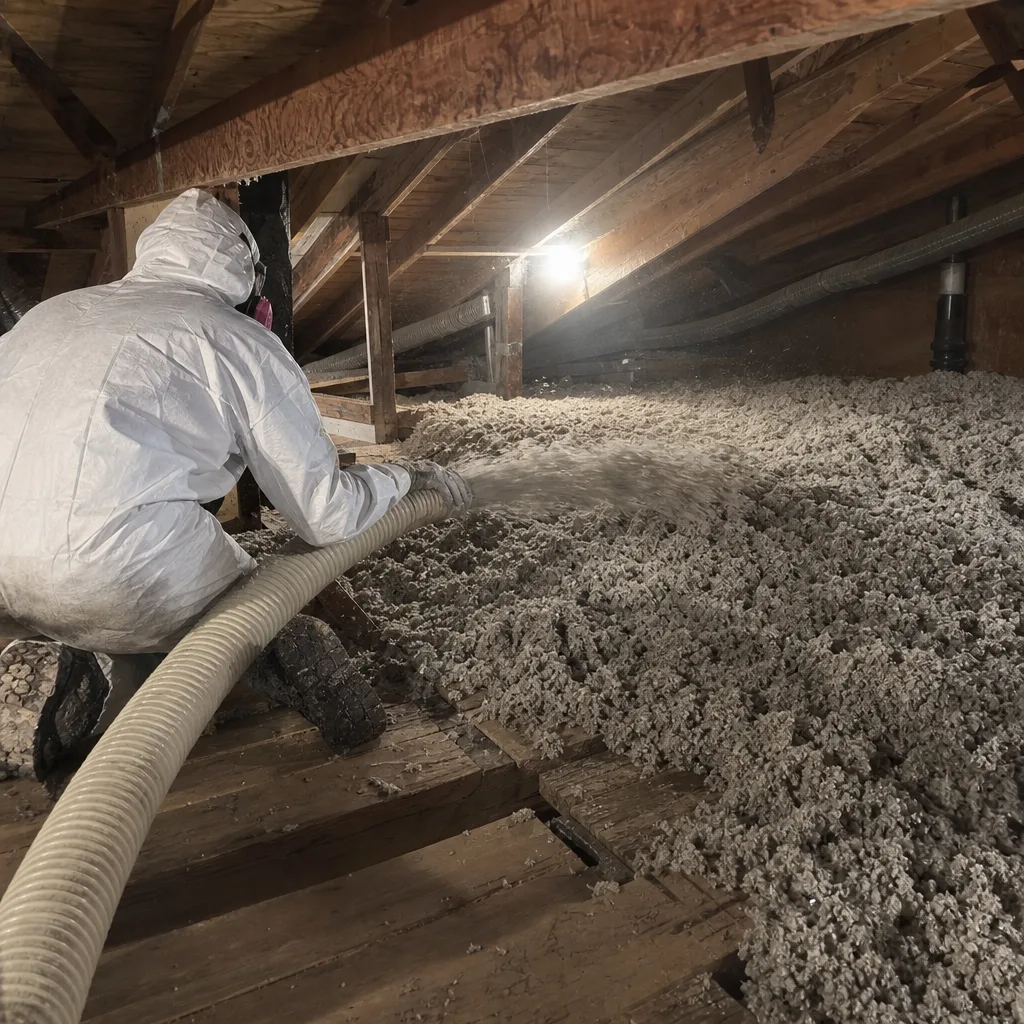
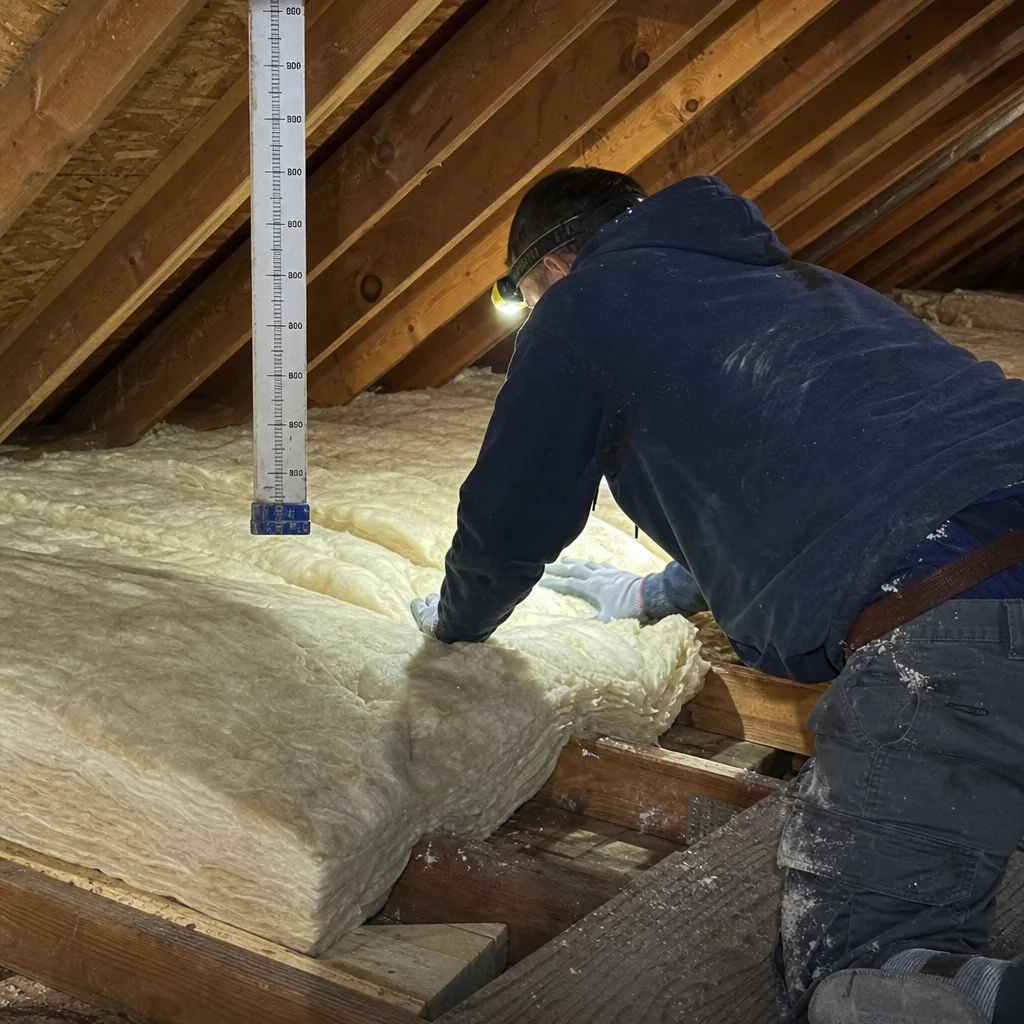
Blown-in installation at manufacturer-specified density. For Rockwool Granulated Wool, we target 1.7 lbs/ft³ in open attics and 3.5 lbs/ft³ for dense-pack walls, verified by cavity-fill calculation and spot-check weighing. We document depth markers and density checks with photos.
- 5
Post-install blower-door test and thermal imaging. We run the blower door again and give you the before-and-after CFM50 number. On every applicable job, this documented record shows the performance change you paid for.
- 6
Cleanup, photo record delivery, and 365-Day Done Right Promise activation. You receive a Documented Photo Record of the completed work, the blower-door readings, and a written attic access summary. If it’s not done right, we make it right.
What Rockwool Blown-In Insulation Costs in Lancaster
Most Rockwool blown-in jobs in Lancaster fall in these ranges:
| Job Type | Typical Range | What Moves the Price |
|---|---|---|
| Attic top-up (existing 6-8 inches, add to R-38) | $1,800 - $2,800 | Attic square footage, access difficulty, whether air sealing is needed first |
| Attic removal + replacement with Rockwool Granulated Wool | $3,200 - $4,800 | Volume of material to remove, contamination level, disposal fees |
| Dense-pack wall insulation (Rockwool in empty stud bays) | $2,400 - $4,200 | Wall square footage, interior or exterior access method, repair of drywall or siding after |
| Air sealing + blown-in insulation package | $2,800 - $5,500 | Pre-sealing CFM50 number (leakier homes take more labor), complexity of chase and soffit detailing |
Prices include material, labor, the pre- and post-work blower-door test, and the Documented Photo Record. We don’t charge extra for the second opinion on a competing quote. Call (661) 526-2890 for a written estimate - estimates are free, and the price we write is the price you pay.
Why Lancaster Homeowners Call Topside Attic Insulation Lancaster for Rockwool Work
We’ve sealed and insulated over 9,000 homes since 2016, and the ones in Lancaster teach you something specific: the high desert’s temperature swings, from 25°F winter mornings to 105°F summer afternoons, stress insulation systems differently than coastal climates. Rockwool’s mineral fiber handles this well when installed right, but “installed right” means sealed first, then insulated, with density verified by weight.
Wes Okafor runs every job with a pre-install air-leak audit. He grew up in Chicago’s South Side and got his start in building science at Dawson Technical Institute, where he logged classroom hours on heat transfer and blower-door diagnostics before most of his peers knew what a CFM reading meant. That training shows up in how we document each project: a before-and-after thermal report, a written attic access summary, and the blower-door number that proves the result.
We’re independent. We’re not a Rockwool dealer, not a Reflectix dealer, not tied to any manufacturer’s volume targets. We source Rockwool Granulated Wool, Comfortbatt, and Comfortboard when they’re the right product for the assembly, and we’ll tell you when another material - Owens Corning fiberglass dense-pack, Johns Manville blown-in, or a hybrid assembly - makes more sense for your specific roof or wall. The Haven Standard requires it: have it in writing, prove it with numbers, make it right if it’s not.
FAQs
Rockwool’s product warranty covers manufacturing defects regardless of who installs it, but installation errors - wrong density, moisture contamination, or compression below labeled thickness - aren’t covered. As an independent Rockwool service provider, we document density, depth, and conditions with photos so you have evidence if a product claim ever arises. Call (661) 526-2890 if you need help understanding your existing warranty terms.
Current Rockwool Granulated Wool is slightly darker gray than batches from 2010-2015 due to a change in basalt sourcing, so a top-up won’t be visually identical. The thermal performance is the same, and we blend the new material into the old at the edges to avoid distinct layers. If visual uniformity matters for a future home sale, we can discuss full replacement.
Top-ups are cheaper upfront, but only if the existing material is dry, uncontaminated, and the attic floor is already air-sealed. In Lancaster, we find that 40% of “simple top-up” calls need more: removal of urine-contaminated material after rodent entry, or air sealing that should have been done years ago. We give you two written prices when both options are viable, with the honest recommendation based on what we find in your attic.
Most Rockwool attic jobs are scheduled within 3-5 business days, dense-pack wall jobs within 5-7 days due to the crew size needed. Emergency situations - post-leak removal, or no insulation after a roof repair - we typically handle next-day. A live person answers calls 24/7, so you’ll know where you stand before you hang up. Call (661) 526-2890 for current availability.
We don’t stock Rockwool in a warehouse; we order to spec for each job from regional distributors in the Los Angeles basin, with typical delivery in 2-3 business days. This means no stale material, no compression from long storage, and no proprietary lock-in. We also work with Reflectix and other brands if your project needs a hybrid approach or if Rockwool lead times extend.
Written by Wes Okafor, Owner & Lead Insulation Technician, Topside Attic Insulation Lancaster at Topside Attic Insulation Lancaster, serving Lancaster and nearby areas.